GOES-16  /  GEOSTATIONARY  /  35,786 KM ALTITUDE

The fire moved faster than anyone could watch.

So we watched it from space. Every few minutes through January 2025, a weather satellite 35,786 km above the Pacific took the temperature of Los Angeles and recorded the Palisades and Eaton fires as they happened.

BEGIN

01 — THE SETUP

Two wet winters had packed the hills above Los Angeles with brush. And on the morning of January 7, fierce Santa Ana winds tore down the canyons, gusting to 95 km/h. The basin was a fuel bed waiting for a spark.

02 — FROM THE GROUND

This is what Los Angeles saw.

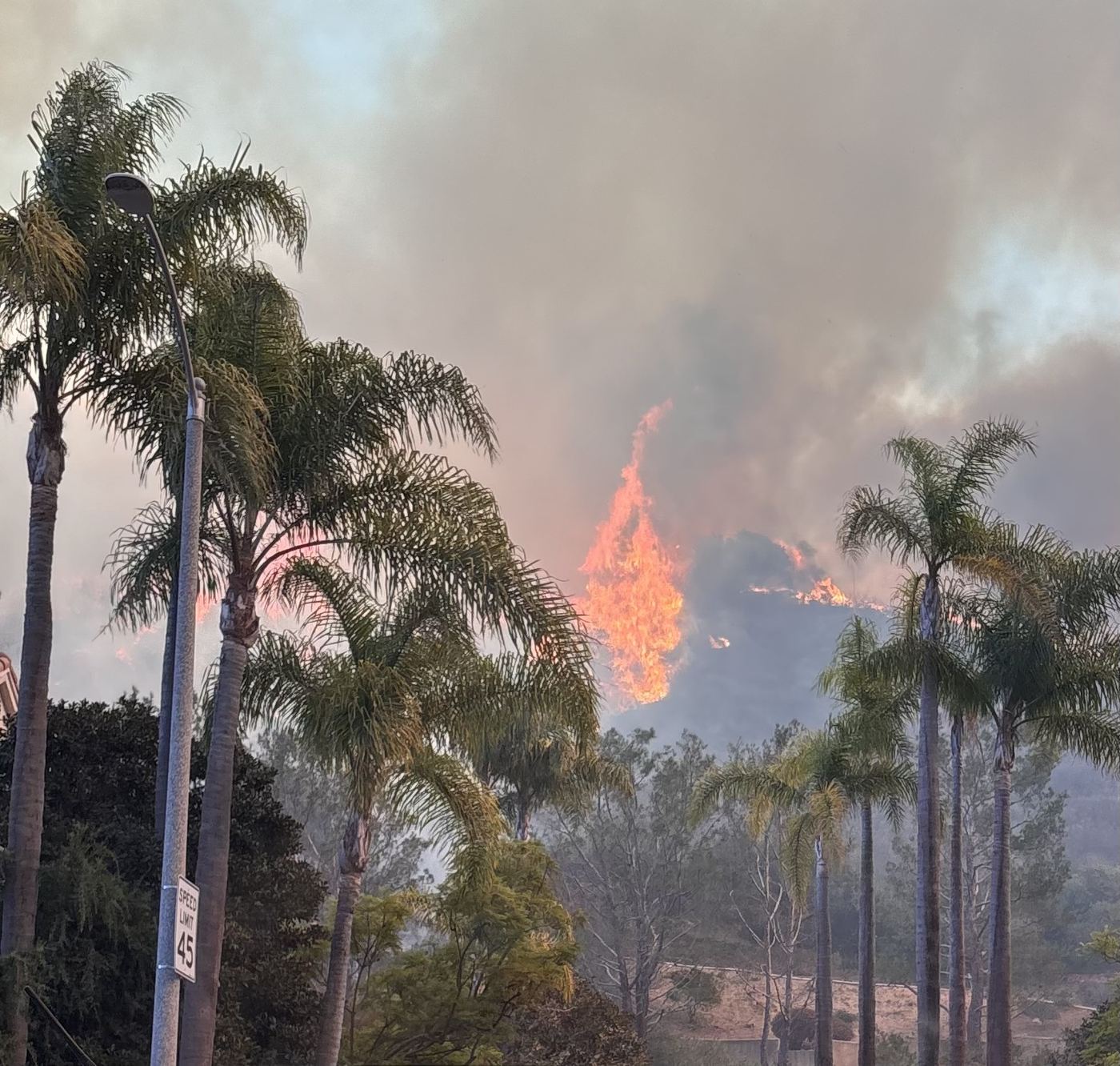
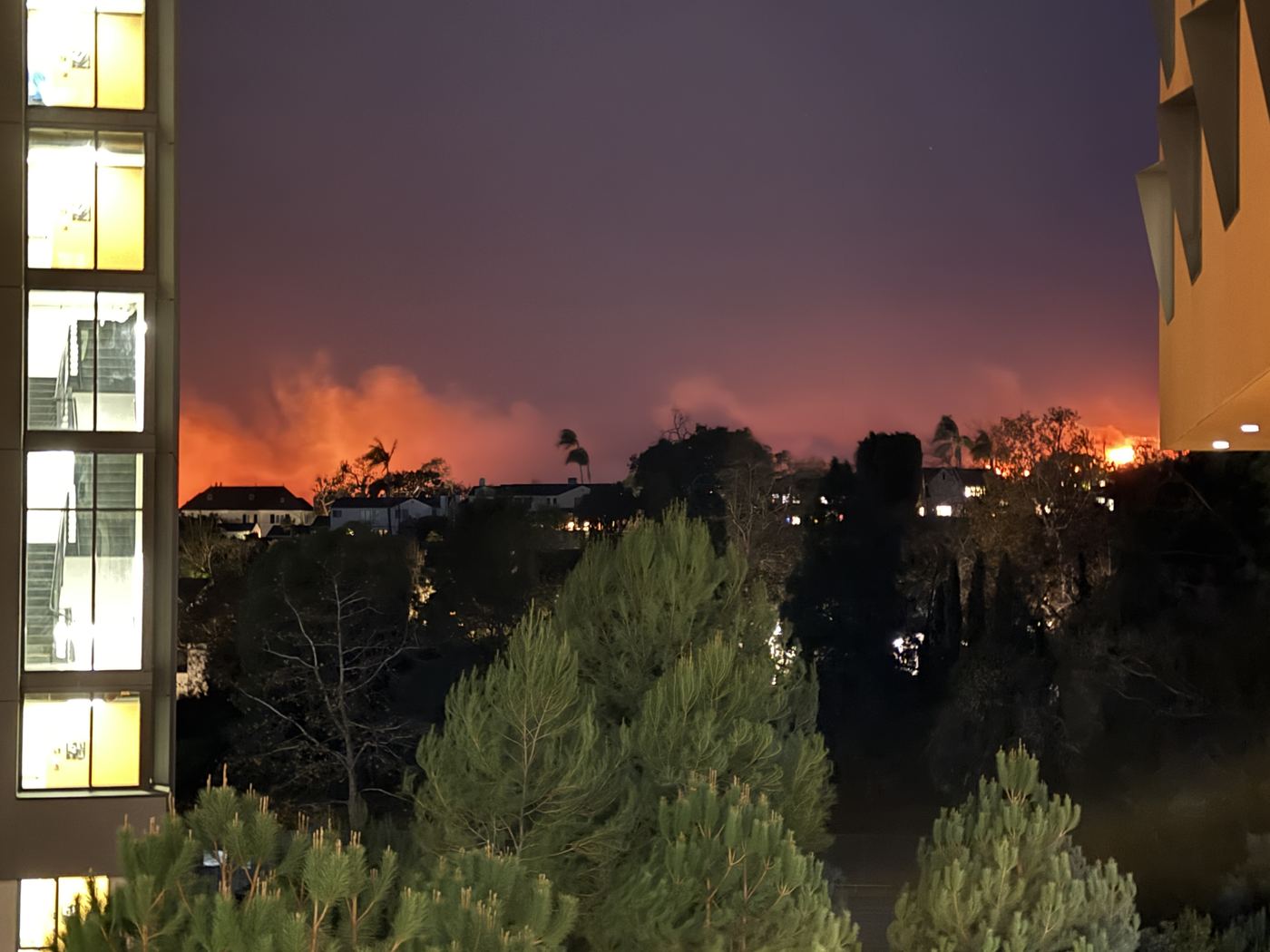
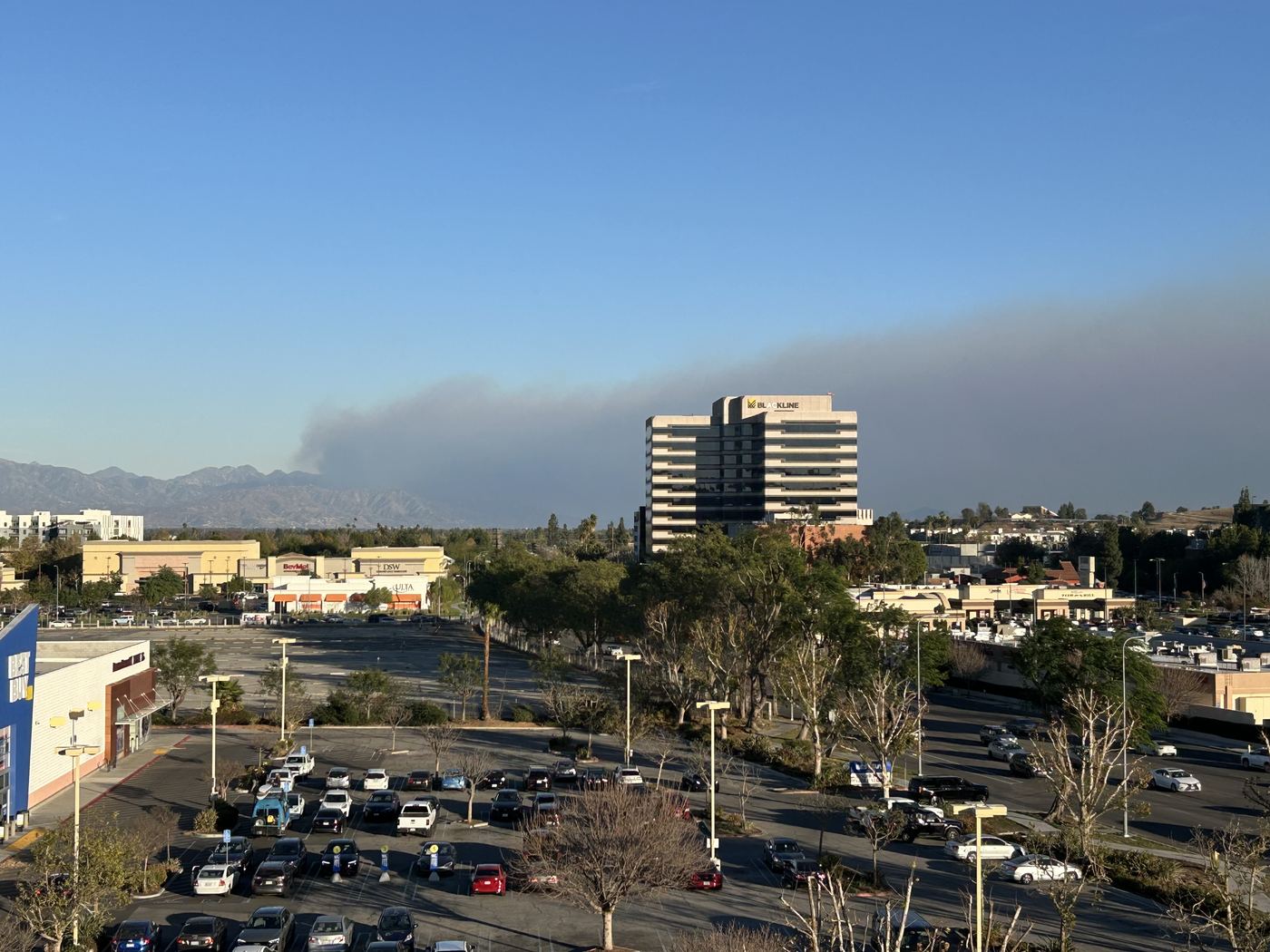
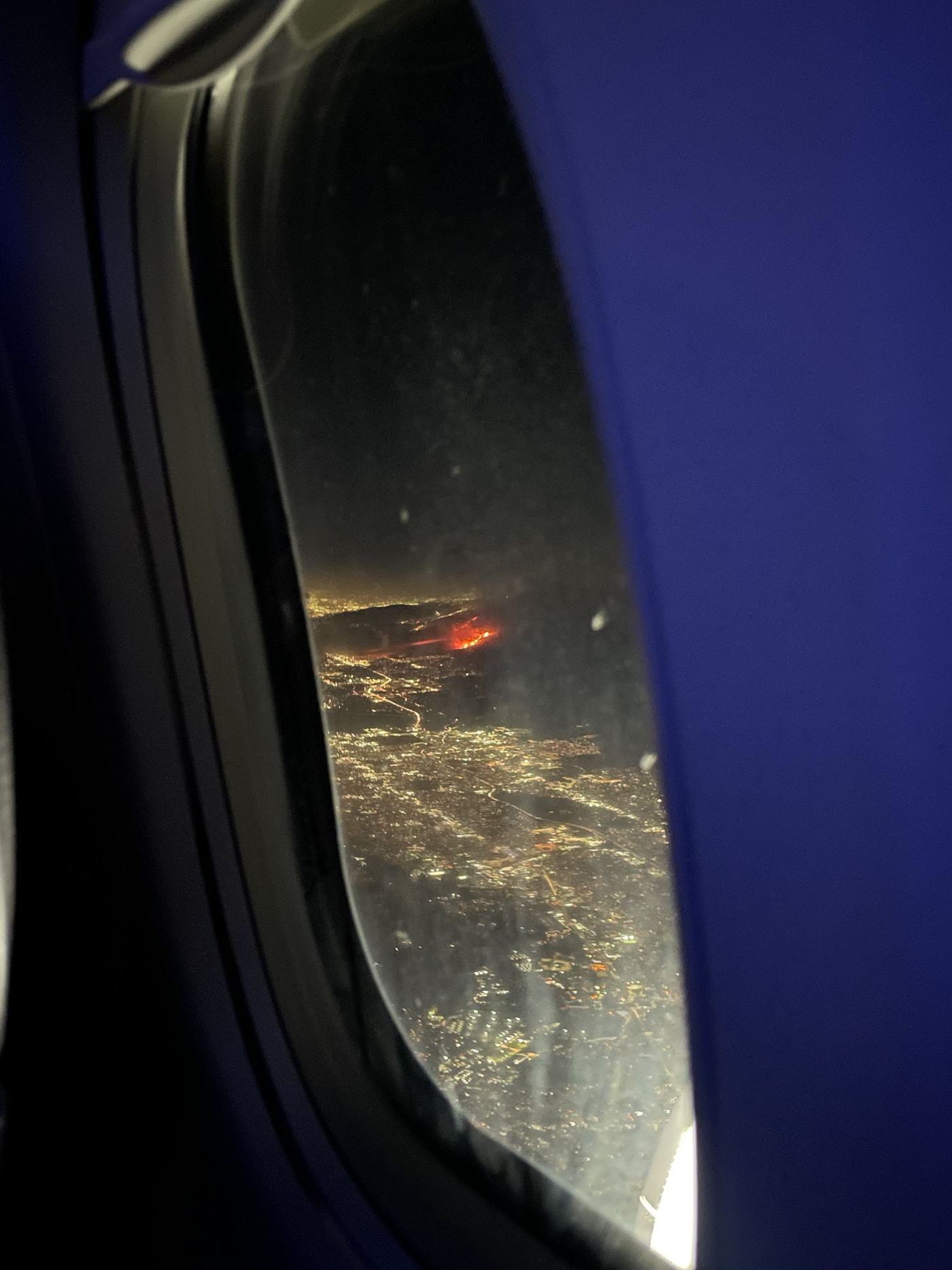
But from the ground it was just smoke on a ridgeline, an orange sky after dark, a plume drifting over the freeway. No one standing in it could see the whole shape of the disaster. These are real photographs from those four days, the same fire we are about to watch from 35,786 km up.

Flames crest a ridge above Pacific Palisades, seen behind palm trees from Palisades Drive.
Palisades Fire Flames on the ridge above Pacific Palisades Ariam23 · CC BY 4.0 · Wikimedia Commons
Night sky glowing orange over a residential hillside, the Palisades Fire seen from UCLA.
Palisades Fire The night sky over the Westside, from UCLA BulkyOS · CC BY 4.0 · Wikimedia Commons
A wall of smoke from the Eaton Fire rises over the San Gabriel Mountains, seen across the basin from Woodland Hills.
Eaton Fire The smoke plume across the basin, from Woodland Hills Busition · CC BY 4.0 · Wikimedia Commons
The Eaton Fire glowing red in the dark hills below a city grid of lights, seen from an airplane window at night.
Eaton Fire Burning in the dark above the city lights, from a passing plane SidewalkMD · CC BY-SA 4.0 · Wikimedia Commons

03 — THE FEED

Scrub through four days of fire.

Each mark below is a single 2 km pixel where GOES-16 detected active fire. The brighter it glows, the more heat the fire is throwing off. That heat output is its radiative power, the number on the readouts. The blue streaks drifting across the map are the Santa Ana wind, and the dial reads its live speed and direction. Watch the fire surge as the wind picks up, or stir the air with your cursor. Scroll to let the satellite walk you through the disaster, or take the controls and explore the four days yourself.

SATELLITE TIMESTAMP (PST)
TOTAL RADIATIVE POWER
ACTIVE FIRE PIXELS
CUMULATIVE FOOTPRINT

FIRE RADIATIVE POWER

10 MWsmoldering 4,000 MWfirestorm

Brighter & larger = more intense burning.

SPEED

RADIATIVE POWER: Palisades   Eaton   Wind  ·  drag to scrub

Space play/pause   step   Home restart

10:36 AM · JAN 7

It begins as a single pixel. A spark in the dry brush above Pacific Palisades registers as 220 megawatts of radiated heat, the first thing the satellite sees.

6:26 PM · JAN 7

Eight hours later, as crews converge on the coast, a second bloom appears 30 km inland above Altadena, the Eaton fire. Now the basin is burning on two fronts at once.

11:00 PM · JAN 7

After dark the Santa Ana winds peak. Together the two fires radiate 43 gigawatts, the heat of roughly forty large power plants. No ground crew can hold a line against this.

5:15 AM · JAN 8

Then, at dawn, the overnight surge passes. Even with the wind still blowing, the fires shrink below the satellite's detection threshold and nearly vanish from the feed. They are not out yet, but they are waiting for the afternoon.

JAN 11: FOUR DAYS ON

GOES-16 has now watched fire touch 216 km² of Los Angeles County. The pulse never resolved into "over", it just slowed. Take the controls: play, scrub the timeline, or hover any pixel to explore the four days yourself.

04 — THE EVIDENCE

Why five minutes matters.

A satellite's cadence is how often it can look, and that comes down to its orbit. A geostationary satellite hovers over the same spot, so it can look every few minutes. A polar-orbiting one circles the planet and passes over Los Angeles only a few times a day. Drag the slider to make the satellite look less often, and watch how much of the fire a slower one would simply never see.

SAMPLING INTERVAL
LOOKS PER DAY
FIRE RHYTHM LOST

05 — THE TAKEAWAY

Therefore: a fire is not an event, it is a rhythm. It surges with the wind, breathes with the daily heat, and outruns the people fighting it. A satellite that looks every few minutes can see that rhythm. But one that looks twice a day cannot. It only sees the aftermath.

THE ONE THING TO REMEMBER

How often you look at a wildfire matters as much as how closely.

5 min GOES-16 caught the full 43 GW firestorm peak and every surge in between.
Twice a day A polar orbiter smooths away up to ~70% of the fire's rise and fall and lands its two daily looks during the calm.

SO WHAT Wildfire response should lean on high-cadence geostationary detection (GOES‑East / GOES‑West) as its early-warning backbone, not the once or twice daily polar passes that arrive after the surge has already jumped the line. When the next Santa Ana event builds, the agencies and residents watching a five-minute feed get hours of warning the twice-daily view never delivers.

06 — PROJECT WRITEUP

What we have done so far

We have built the full data pipeline and the interactive visualizations shown above. A Python tool scans all 1,440 five-minute GOES-16 fire scans from January 7-11, 2025 and extracts every fire pixel inside the Los Angeles basin, and there are 7,790 detections in total. We then sort each into the Palisades fire, the Eaton fire, or other nearby activity. From that dataset we built a scrollytelling visualization with an animated map the reader can play, pause, and scrub, as well as a synchronized radiative-power timeline, on-map annotations for the key moments, and live instrument readouts. We also made a second interactive visualization to let the readers resample the data and see for themselves why GOES's high cadence matters. To ground the story's claim that a fire "surges with the wind," we layered in the real Santa Ana wind from ERA5 reanalysis, aligned frame-for-frame with the fire, so the reader can watch the two rise and fall together.

The most challenging part to design

The hardest design problem is making time itself legible. GOES samples every few minutes for more than four days, which is far too many frames to show at once. Yet, the story is in exactly those fine-grained changes, since a strong wind can double a fire in under an hour. We had to design interactions that let a reader move fluidly between the big picture and the telling detail without losing their place. A second challenge is honest encoding: detections are intermittent and noisy, so our heat-decay rendering must feel like a living fire without inventing data the satellite never recorded. Balancing emotional impact against that scientific honesty is a pretty challenging aspect of this project.